- Home QZ
- Laying Floors
- Could your old floor tiles contain asbestos
Could your old floor tiles contain asbestos
Asbestos tiles can hide under old carpet in older homes. Learn where they turn up, why an accredited pro should take samples and what your options are.
Guide by Nora Mattingly
5 min of reading
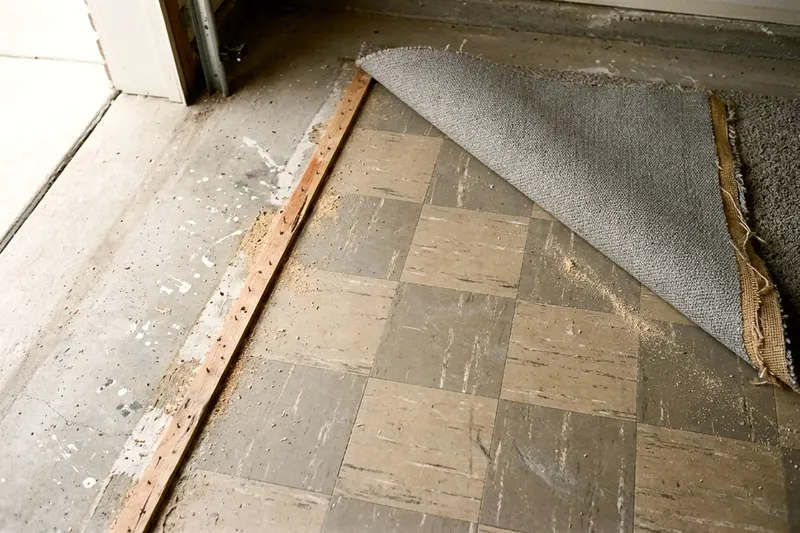
Old floor tiles in your home could contain asbestos. You often discover these hard, glued squares hiding under a layer of old carpet. Samples taken by an accredited asbestos professional and analyzed in a lab are how you find out whether they contain it.
Where asbestos turns up in older floors
Pulling up carpet often reveals a hard floor underneath. You might find a grid of square tiles glued directly to a concrete slab. You might also uncover a sheet of older flooring.
Older houses often hide multiple layers of flooring. Previous owners simply stacked new styles on top of the old ones.
The EPA lists vinyl floor tiles and the backing on vinyl sheet flooring and adhesives among places asbestos may be found. You have to look at the entire flooring system. The square tile itself is a potential source. The backing attached to a continuous sheet of vinyl is another.
The adhesive holding these materials down may also contain asbestos. Treat the tile, the backing and the adhesive all as suspect.
Finding a suspicious floor does not ruin your renovation. It just means you have to pause your work. Keep your new flooring tools in their boxes. Treat the old tile and floor glue as suspect materials until you know for sure.
Why you cannot tell by looking
You might want to inspect the old floor closely to figure out what it is made of. Do not rely on visual checks. The EPA says you generally cannot tell whether a material contains asbestos by looking at it unless it is labeled.
Older building materials can look just like materials without asbestos. A vinyl tile glued to your concrete slab looks like any ordinary piece of flooring. The dark adhesive stuck to the wood subfloor looks like normal construction glue.
You will rarely find a clear manufacturer label printed on old flooring. Treat any old floor as suspect material until a physical test proves otherwise.
What not to do to suspect tiles
Your first instinct might be to scrape up the old floor. You want to reach the clean subfloor beneath it to start fresh. Stop and leave the old surface exactly as you found it. The EPA advises not to sand or try to level asbestos flooring or its backing.
You must also never use a power stripper on flooring that may contain asbestos. Scraping and stripping break the flooring materials apart.
The EPA also advises against sawing, sanding, scraping or drilling asbestos-containing materials. If the floor contains asbestos, breaking the tiles or the adhesive can release fibers into your home.
You must adjust your project plan if your new flooring requires a sanded subfloor. You cannot run a sander over the old vinyl to smooth out the curled edges.
Keep your scrapers away from the old floor. You must find another way to install your new floor without disturbing the suspect materials.
How testing works and who should take samples
To know whether your floor has asbestos, a sample has to be analyzed in a lab. The EPA says taking samples yourself is not recommended, so do not cut, scrape or break the floor to collect one. A trained and accredited asbestos professional should take the samples for analysis.
The accredited professional knows how to secure the material without disturbing the rest of your house.
The professional transports the material to a specialized laboratory. The laboratory tests the physical sample and sends back an official report. This report details exactly what is in your floor.
You can decide how to move forward once you have the test results. Wait for the final lab report before you resume any work. Do not move furniture back in. Do not start opening boxes of new flooring until you know what you are dealing with.
Leave them, cover them or hire an accredited pro
You have a few straightforward options once a lab test confirms the floor contains asbestos. The easiest choice is often to do nothing to the floor at all. The EPA says undamaged asbestos containing material that will not be disturbed should be left alone.
The tiles might sit flat on the subfloor. They might show no signs of breaking or crumbling. You can leave them in place if they are undamaged and will not be disturbed.
Your second option is to cover the old floor. The EPA suggests installing new covering over asbestos flooring if possible, and an accredited professional should confirm that it suits your floor. You cannot sand the high spots or scrape the old glue. You also cannot drill into the old floor.
A floating floor, which clicks together over an underlayment pad, is one kind of covering to ask your professional about. You might wonder does laminate flooring need underlayment over old tile.
A pad can keep the new planks off the old surface and leave the suspect tiles untouched beneath them. That kind of covering is an option if you are laying vinyl plank flooring over an old floor.
Your third option is complete removal. The EPA says removal is complex and must be done only by a trained and accredited asbestos professional. You cannot rip the floor out yourself.
Hiring a professional costs money, but it leaves a bare subfloor. That helps if you want to learn how to install laminate flooring in one room. You will not have to worry about the height of an old floor underneath.
Ask your state agency before any removal
Rules for handling asbestos vary by state. The EPA says many states run their own asbestos program. The EPA points homeowners to their state environmental protection or health department. You should contact them before you schedule any removal work.
The EPA points homeowners to the state agency as the place to ask what rules apply to your home. You can find the contact details for your local department online. Check with them so you know what applies in your area.
The EPA says homeowners should make sure hired workers are trained and accredited. Ask the contractor for proof of training and accreditation, then ask your state agency how to check it.
Line up your next job
-
9 tips for peel and stick floor tile that stays down
A proper prep routine and heavy rolling keep your peel and stick floor tile flat and help stop the corners from lifting after you finish the room.
-
Does laminate flooring need underlayment
Find out when you need a separate laminate flooring underlayment to protect your planks and when a concrete subfloor demands a plastic vapor barrier.
-
Laying vinyl plank flooring over an old floor
Learn the steps for a successful vinyl plank flooring installation over your existing floor including how to prep the surface and lock the boards in place.